
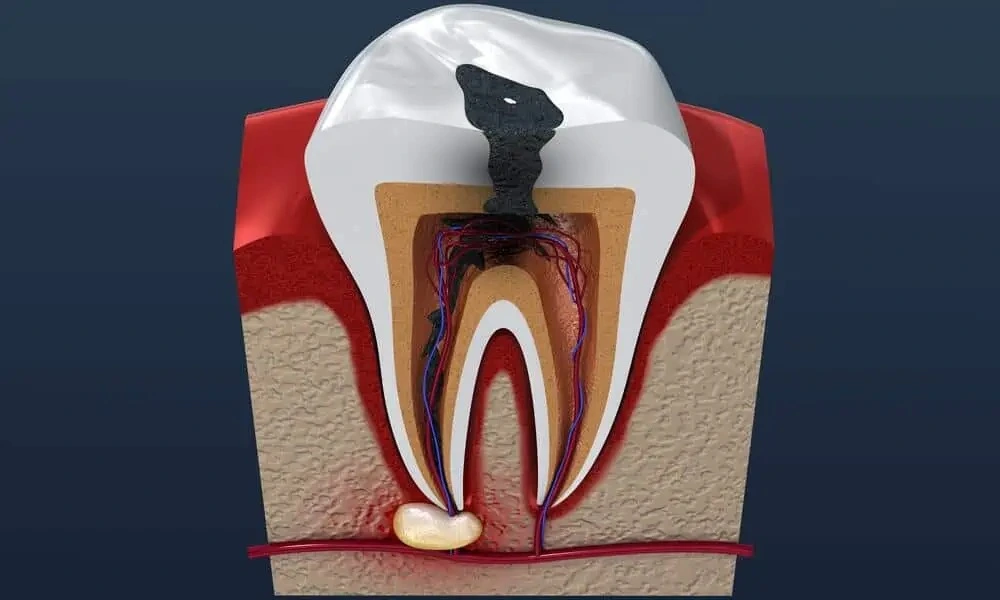
When a tooth becomes infected, the infection may progress to a more serious condition known as a tooth abscess, which is a collection of pus and dead cells inside the tooth cavity.
A tooth abscess is characterized by its prominent and painful appearance, and it can have negative effects on a person's overall health if it is not treated properly and in a timely manner.
In this article, Dr. Mohammad Khaled Nofal, specialist in dentistry, cosmetic dentistry, and dental implants, discusses how to recognize the appearance of a tooth abscess, the causes of its occurrence, and the most notable methods used to treat it and eliminate it effectively.
Tooth abscess
The appearance of a tooth abscess may vary depending on the type of abscess and its location inside the mouth, but it usually has a distinctive appearance. Here is a description of what a tooth abscess may look like:
Swelling
The affected tooth may appear slightly swollen or clearly swollen, and the swelling may be limited to a specific area around the root or the gum surrounding the tooth.
In addition, swelling may appear in the tissues surrounding the tooth, which is usually soft to the touch and may be painful when pressed.
Change in gum color
The color of the gum surrounding the affected tooth may change to red, which indicates inflammation.
Formation of a white or yellow spot
If the abscess develops to the stage of pus accumulation, there may be a white or yellow spot on the gum surrounding the tooth.
Appearance of a hard lump
If the abscess develops to an advanced stage, there may be a mass or hard lump that appears in the gum or jaw surrounding the tooth.
What does the pain of a tooth abscess feel like?
If you have a tooth abscess, you might describe the pain as follows:
Sharp, distressing pain that may increase over time.
A throbbing sensation in the affected area.
Constant, unrelenting pain.
Pain spreading to the jaw bones, the neck, or the ear.
Symptoms accompanying a tooth abscess
It may include many signs and symptoms that indicate the presence of an abscess. Dr. Mohammad lists for you some common signs that may appear with a tooth abscess:
Enlargement of the gum due to swelling.
Appearance of ulcers in the area surrounding the affected tooth.
Discharge of pus from the affected tooth, which occurs in severe cases.
The tooth or affected area may be very sensitive, especially when pressed on it or when consuming cold food and drink.
A bitter taste in the mouth.
Elevated temperature.
Bad breath.
General discomfort, unease, or feeling ill.
Causes of an abscess
Anything that helps bacteria reach the teeth or surrounding tissues can lead to a tooth abscess. The causes include the following:
Tooth decay
Any area in the mouth where there are severe cavities as a result of tooth decay helps destroy the hard surface of the teeth.
This occurs when bacteria break down the sugars in food and drink, leading to the formation of an acid that attacks the enamel.
Broken or cracked teeth
Bacteria can seep into any opening in the tooth and spread to the pulp, especially in the case of broken or cracked teeth.
Gum disease
Gum disease is an infection and inflammation of the tissues surrounding the teeth, but as gum disease progresses, bacteria are able to reach the deep tissues and form a tooth abscess.
Tooth injury
A tooth injury may damage the inner pulp even if there is no visible crack, and the injury makes it susceptible to infection.
Who is at risk of a tooth abscess?
The risk of this condition increases if you have one of the following factors:
Smoking: People who smoke are twice as likely to develop tooth abscesses compared to people who do not smoke.
Dry mouth: The amount of bacteria in the mouth increases when there is a small amount of saliva.
Poor oral hygiene: Not brushing and flossing the teeth regularly leads to an increase in bacteria.
Weak immune system: Some diseases or medications can reduce the immune response, making it more difficult to fight off germs.
Methods for diagnosing a tooth abscess
Below are some common methods that can be used to diagnose a tooth abscess:
Clinical examination
The dentist examines the mouth and the affected tooth to look for signs of swelling, redness, and inflammation.
In addition, the dentist may press on the gum surrounding the tooth to determine the extent of pain or sensitivity, and a thin needle may also be used to take a sample of the pus if it is available.
X-rays
X-rays can be used to check for the presence of an abscess and determine its location precisely, and they can also help determine the size of the abscess and assess the extent of its effect on the roots and surrounding bone.
CT scan
A CT scan is recommended to check whether the infection has spread to other areas within the neck, and to help determine the extent of the infection in general.
Treatment methods
The goals of treatment are to eliminate the infection and prevent complications, so the treatment of a tooth abscess depends on the severity of the abscess and the type of infection causing it.
In simple cases, treatment may be limited to helping relieve pain and swelling, while in more complex cases surgical intervention may be required.
The options for treating a tooth abscess include the following:
Medication treatment
This includes the following:
Antibiotics: Antibiotics are usually given to help fight the bacterial infection causing the abscess.
Pain relievers: Pain relievers such as paracetamol or ibuprofen can be used to relieve pain and swelling.
Tooth extraction
Sometimes, a tooth with an abscess becomes irreparably damaged, and in these cases, the dentist may need to extract or pull the tooth.
Surgical procedures
Such as:
Incision and drainage of the pus: In some cases, it may be necessary to open the abscess and drain the pus to reduce swelling and pain, by making a small incision in the abscess.
Root canal or root treatment: If there is inflammation in the nerve or the roots, surgery may be required to treat the nerve or remove the root of the affected tooth.
Read also: Immediate dental implants
Can a tooth abscess disappear on its own?
A tooth abscess will not disappear on its own. The pain may stop if the infection causes the pulp inside the tooth to die.
The pain stops because the nerve is no longer functioning, so the patient may not be able to feel it. However, the bacteria will continue to spread and destroy the surrounding tissues.
We advise you, if you are experiencing symptoms of a tooth abscess, to visit the dentist even if there is no longer any pain.
How does a tooth abscess affect oral health and overall health?
If left untreated, a tooth abscess can spread to the jaw bone, the soft tissues of the face and neck, and beyond.
In extremely rare cases, the infection can travel to the heart, causing endocarditis, or it may travel to the brain, causing bacterial meningitis.
In conclusion, a tooth abscess is a medical problem that requires immediate evaluation and treatment to maintain oral health and prevent potential complications.
Sources
- Professional, C. C. M. (n.d.). Abscessed tooth. Cleveland Clinic. https://my.clevelandclinic.org/health/diseases/10943-abscessed-tooth
- Website, N. (2022, June 28). Dental abscess. nhs.uk. https://www.nhs.uk/conditions/dental-abscess/
- Tooth abscess – Symptoms & causes – Mayo Clinic. (2022, June 29). Mayo Clinic. https://www.mayoclinic.org/diseases-conditions/tooth-abscess/symptoms-causes/syc-20350901
- Duran, R. (2021, November 13). What is an abscessed tooth? WebMD. https://www.webmd.com/oral-health/abscessed-tooth
- Santos-Longhurst, A. (2023, February 14). Abscessed tooth: What you need to know. Healthline. https://www.healthline.com/health/abscessed-tooth