In the advanced world of dentistry, dental implants have come to play a major role in improving the quality of life for many people who have lost one or more of their teeth. But did you know that there are alternatives for replacing missing teeth in innovative and effective ways that provide similar results, but through different methods?
In this article, Dr. Mohammad Khaled Nofal, specialist in dentistry, cosmetic dentistry, and dental implants, gives you an overview of these alternatives and how effective they are in replacing missing teeth.
Alternatives to dental implants for missing teeth
There are several alternatives to dental implants for replacing missing teeth, including:
Dental bridges
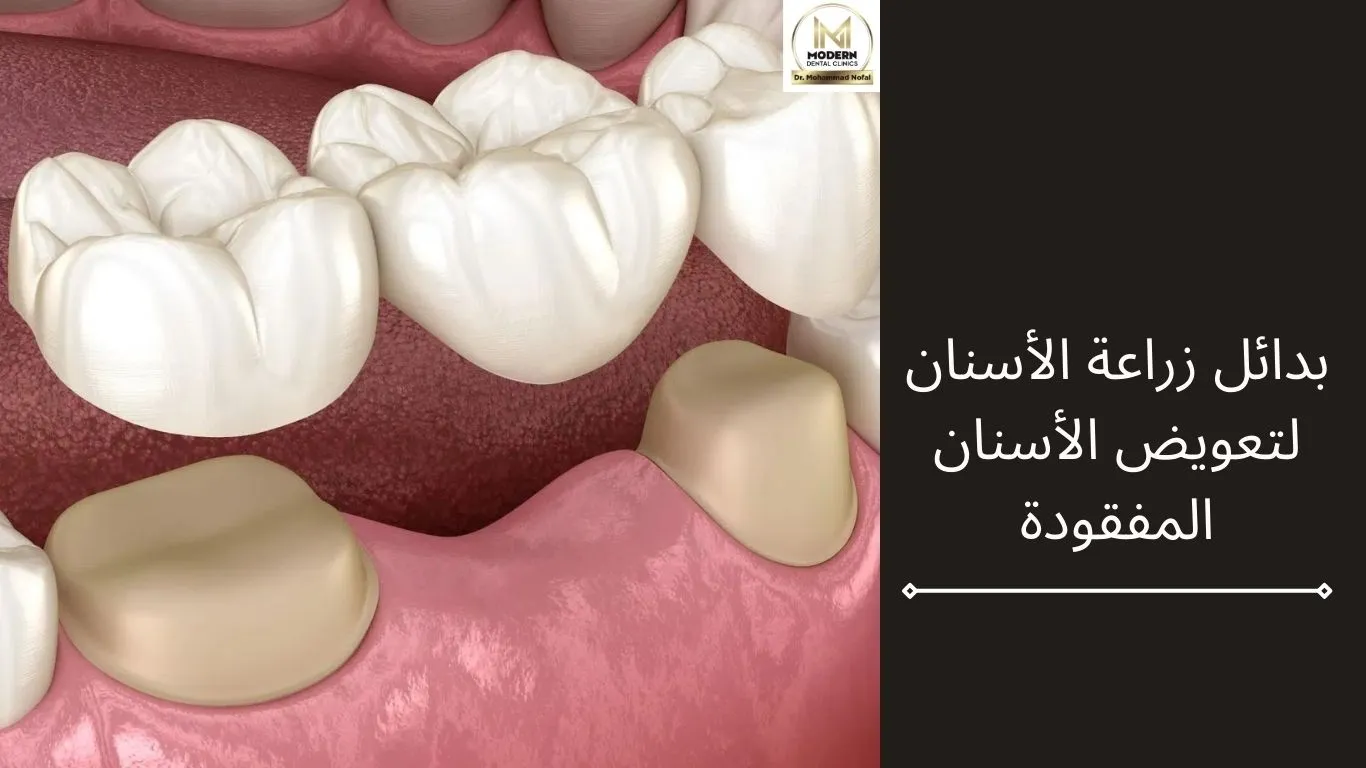
Dental bridges are a means of replacing missing teeth using an artificial bridge that is fitted in the place where the teeth were lost. This method allows the natural appearance and functions of the teeth to be restored.
Dental bridges are generally recommended when the number of missing teeth is small, that is, in the case of losing a single tooth or a few teeth.
There are two main types of dental bridges:
Fixed (bonded) bridges
These involve fitting permanent artificial teeth made of materials such as porcelain, metal, or zirconia onto a metal bridge, which is fixed next to the teeth adjacent to the missing tooth on each side using special bonding agents.
Among the advantages of fixed bridges is that they provide a stable, permanent solution that resembles natural teeth in shape and function, and their placement is easy and safe.
Removable bridges
Removable dental bridges are bridges made of a plastic or metal base that holds the artificial teeth. They are a means of replacing missing teeth, and are usually used when it is not possible to use fixed bridges or dental implants.
These bridges are considered less costly compared to fixed bridges or dental implants, and they offer the patient some possibilities for removing and cleaning them.
Dentures
Dentures are also a good alternative, as they are often comfortable and resemble natural teeth in shape. They are designed to fit the structure of the mouth and replace missing teeth comfortably.
Dentures are often available in several types, which are:
Partial dentures
These are dentures designed to replace a certain number of missing teeth and support the remaining teeth. These dentures can also be easily adjusted and adapted to suit any changes in the jaw or teeth.
Thanks to modern techniques and the materials used, they can be designed to look natural and to match the shape, color, and function of the individual’s natural teeth, in addition to being removable and able to be cleaned regularly.
Complete dentures
These are a means of replacing all the missing teeth in the upper or lower jaw. These dentures consist of artificial teeth made of plastic or ceramic, designed to look and function like natural teeth.
It is worth noting that complete dentures help the patient eat and speak naturally and effectively.
Implant-supported dentures
Implant-supported dentures are a technique in dentistry used to replace missing teeth, in which dental implants are used to permanently fix the artificial teeth in the jaw. This type is often made of safe, durable materials such as titanium.
They are meticulously designed to look like natural teeth and give a natural impression when smiling and speaking, in addition to providing natural, effective function in eating and speaking, which helps the patient fully restore the natural functions of the mouth.
Read also: Caring for dentures
Removable appliances (retainers/partials)
Removable appliances, also known as “flippers,” are devices used to replace missing teeth and are considered a removable, non-permanent option for tooth replacement.
These appliances are designed to be a good option for people who cannot use fixed bridges or dental implants due to problems in the gums or jawbone, in addition to being less costly compared to other procedures.
How to choose the appropriate alternative to dental implants
Dental implants are considered one of the effective and durable solutions for replacing missing teeth, but they are not always the optimal and best choice for all cases. As for the optimal option for replacing missing teeth, Dr. Mohammad emphasizes that it depends on several factors, including:
The patient’s age and general health.
The overall health of the mouth and gums.
The number of missing teeth and the condition of the remaining teeth.
The patient’s personal preferences.
The patient’s financial ability.
Therefore, dental implants are not always the optimal and best choice, and the available options should be considered and a specialized dentist consulted to assess your condition and determine the best option for you based on your needs and your health and financial circumstances.
In which cases can alternatives to dental implants be used for missing teeth?
The cases include the following:
Insufficient bone quantity in the jaw to perform dental implants.
People who suffer from gum problems.
Special medical conditions that prevent dental implants.
The high cost of dental implants compared to other alternatives.
People who wish to improve the appearance of their teeth quickly.
Removable alternatives may be used temporarily before performing dental implants or for a certain stage during treatment.
Cases that need dental implants rather than alternatives
Dental implants are considered one of the most effective and lasting solutions for replacing missing teeth, but there are some cases that may make dental implants the only or most suitable choice.
Here are some cases that may call for dental implants:
Complete loss of teeth in the jaw
When there is complete loss of teeth in the upper or lower jaw, dental implants may be the optimal choice for replacing these teeth.
People who suffer from gum and bone diseases
Some diseases, such as advanced gum disease and bone disease, may prevent the use of removable appliances or bridges, which makes dental implants the only or most suitable choice.
Severe cosmetic needs
Some cases require achieving a natural, attractive appearance of the teeth, and dental implants may be the optimal choice for achieving this goal.
Read also: Orthodontics and its modern types
And remember that whether you are looking for a permanent or temporary solution, there are multiple options that suit your needs and provide natural, beautiful results that restore your confidence in your smile.
Sources
- What are the alternatives to dental implants? Read our guide. (n.d.). North Sydney Dental Practice. https://www.northsydneydentalpractice.com.au/what-are-the-alternatives-to-dental-implants/
- Know your options: Alternatives for dental implants. (n.d.). https://www.smilearizonadentistry.com/blog/alternatives-for-dental-implants
- Hussein, S. S. (2024, January 29). 6 Alternatives To Conventional Dental Implants – The Dental Centre. The Dental Centre. https://thedentalcentrelondon.com/news/6-alternatives-to-conventional-dental-implants/
- The 5 less invasive alternatives to dental implants | Dental Centre Mallorca. (2024, April 11). Dentalcentremallorca. https://www.dentalcentremallorca.es/post/alternatives-to-dental-implants
- Dental, M. (2024, February 16). Dental implant alternatives: Think about these! – Mint Dental. Mint Dental. https://mintdentalmn.com/dental-implant-alternatives/
- Boondental. (2023, July 10). Is there an alternative to dental implants? Boon Dental. https://boondental.com.au/is-there-an-alternative-to-dental-implants