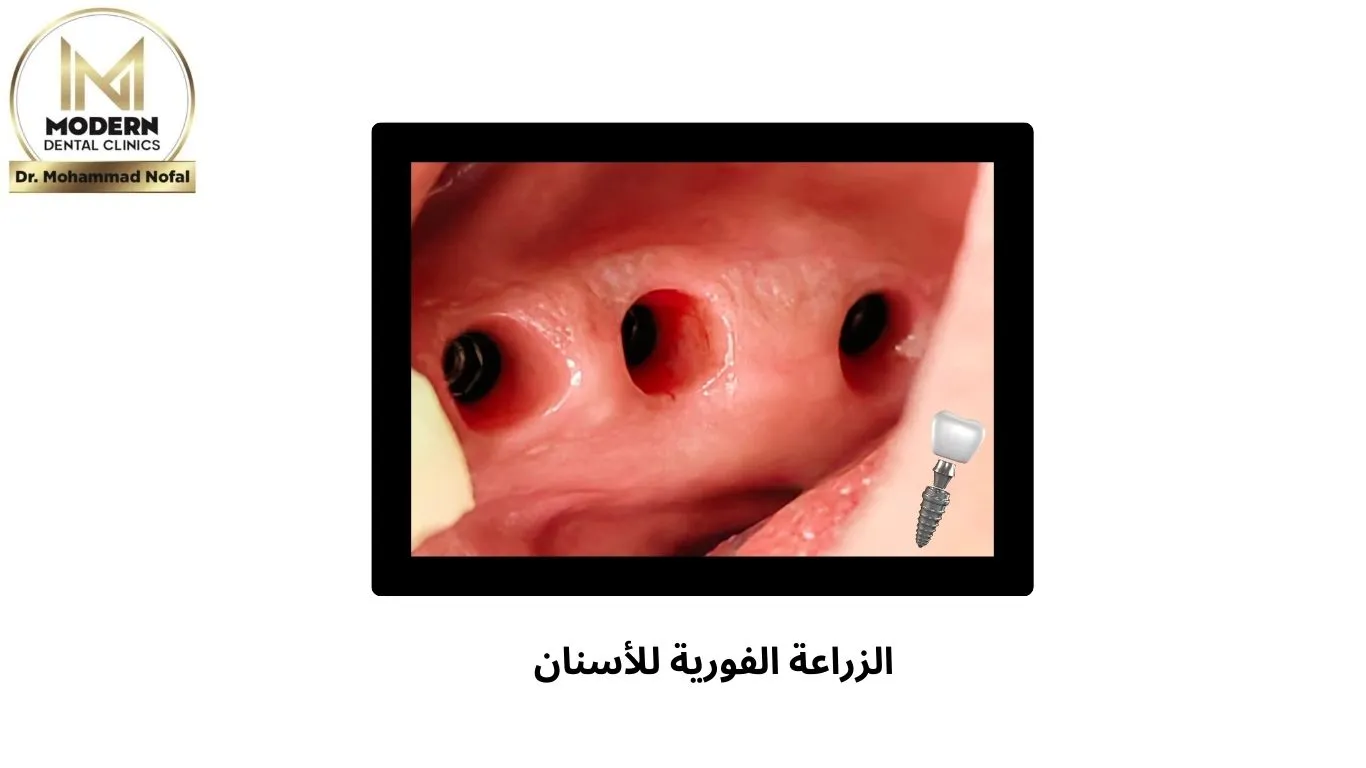
Immediate dental implants
Immediate dental implants, or computer-guided dental implants, are considered one of the advanced and remarkable medical procedures with limitless advantages. Previously, dental implants required more time and effort, and now it has become possible to place implants with fewer steps and without surgical intervention.
To learn more about 3D surgery-free and pain-free dental implants, continue reading the article.
What are immediate dental implants
Immediate dental implants are a non-surgical, painless medical procedure that involves 3D imaging of the jaws to study the case.[1]
These images are analyzed in a simulation program to design and determine the positions of the implants in the mouth, allowing the dentist to plan the procedure precisely before performing it, and thereby obtain the best implant operation that meets the patient's requirements.[1]
Advantages of immediate dental implants
There are many advantages and benefits to immediate dental implants, which is why Dr. Mohammad Khaled Nofal uses them in the best ways.[2]
The advantages of computer-guided dental implant technology include:[3]
A precise and safe procedure
The most important advantage of immediate dental implants is that they enable the dentist to place the implants more precisely than traditional methods.
Reducing the likelihood of complications
The anatomical structures of the jaw, teeth, and surrounding tissues can be obtained using this advanced technology to reduce the risk of unexpected complications during the surgical operation, in addition to allowing the surgeon to precisely determine where the implant procedure should take place.
Reducing the operation time
Computer-guided dental surgery allows the dentist to complete the procedure faster than traditional dental implants, to ensure that patients are able to begin the recovery process earlier.
Read also: Dental veneers
Restoring tooth function immediately
Traditional dental implants require a period of between 3 and 6 months to recover from them before full tooth function is restored.
But with immediate dental implants, the implant can be performed on the same day, allowing the patient to enjoy tooth function after a single appointment with the dentist.
Enhancing patient education
The images obtained by this procedure help the dentist explain the dental implant procedure to the patient, in addition to educating them about overall oral health.
A damaged jaw bone will not be a problem
With traditional dental implants, the patient may need a bone graft or a sinus lift to graft bone before the dentist can perform the implant as a replacement for the missing teeth.
But with the use of computer-guided implant technology, the dentist can see the unique structure of the jaw bone, allowing them to position the implants ideally, even if the patient is suffering from bone loss.
The ability to make adjustments easily
Immediate dental implants allow the dentist to see the exact location of the existing implants to make the necessary adjustments and ensure that no additional implants are placed in those locations.
Read also: 6 steps you must do after tooth extraction to avoid bleeding and infections
The method of performing immediate dental implants
This technique is distinguished in that the implant can be placed immediately after extraction, and the method of the procedure includes the following:[3]
Taking precise measurements of the jaws to prepare the treatment.
Capturing 3D images of the mouth using advanced imaging.
The dentist enters the data and images into a 3D simulation program to determine the type and direction of the implant.
Creating a plan for how to place the implants precisely without the need for a surgical incision.
The dentist begins placing the implants precisely and painlessly according to the design of the operation.
After completing the dental implant procedure, the patient can leave the clinic immediately.
Why are implants better than a bridge?
It can be said that immediate dental implants are better than a bridge for the following reasons:[4]
Dental implants are considered a better option than a bridge because they last a long time, for several years and even a lifetime if cared for properly.
They also adapt easily to the adjacent teeth compared to dental bridges, which tend to weaken the teeth adjacent to them and over time cause more tooth loss.
There is difficulty in using dental floss and cleaning a dental bridge, unlike dental implants, which are distinguished by the ease of using floss well around the implants.
Although dental implants require a complex surgical procedure, once they are placed correctly they can be considered real teeth and become part of the mouth compared to bridges.
During the bridge procedure, the dentist will have to shave part of the healthy teeth adjacent to the missing teeth to fit the bridge onto them, and this is something that does not need to be done in implant cases.
Sources
- What is Computer-Guided Implant Surgery Audubon NJ, Michael Katz DMD PC. (n.d.). https://www.michaelkatzdmd.com/new-3d-technology/what-is-computer-guided-implant-surgery/
- Sirikrai, D. (2022, August 17). The Pros and Cons of Computer Guided Dental Implant Surgery.https://www.thantakit.com/the-pros-and-cons-of-computer-guided-dental-implant-surgery/
- H., Cummings, L. C., & H. (2022, June 6). What is Computer-Guided Implant Surgery & Its Benefits? Houston Oral Healthcare Specialists. https://www.houstonoralhealthcarespecialists.com/what-is-computer-guided-implant-surgery-and-its-benefits/
- Is an Implant Better Than a Bridge? | Dr. Q Dental. (2023, October 27). Dr. Q Dental |. https://drqdental.net/blog/is-implant-better-than-bridge/#:~:text
- Dental veneers: everything you need to know
- Getting beautiful teeth and a wonderful smile like a celebrity's smile or a Hollywood smile is what most people aspire to, and this in itself can be easily achieved through dental veneers.
- So what are dental veneers? And what are their advantages? Dr. Mohammad Khaled Nofal, specialist in dentistry, cosmetic dentistry, and dental implants, answers these questions for us in this article.
- Dental veneers: what are they?
- Dental veneers, also called porcelain veneers or dental contact lenses, are a thin layer or shell made of high-quality materials, such as porcelain or composite materials, that are applied to the surface of the teeth to improve their appearance.[1]
- Dental veneers are considered a cosmetic procedure and are not like dental implants; rather, the natural tooth remains present as a base for fitting the porcelain shell, so that it appears very similar to natural teeth.[1]
- Cases in which dental veneers can be used
- Dental veneers, or porcelain veneers, are considered a suitable option for people who seek to have a bright, radiant smile and even, aligned teeth.[1]
- Therefore, they can be used in the following cases:[1]
- Restoring broken teeth.
- Closing gaps or spaces between the teeth.
- Eliminating pigmentation or stains that do not improve with teeth whitening.
- Repairing the appearance of very small teeth.
- Restoring deformed teeth, such as pointed or abnormally shaped teeth.
- Types of dental veneers
- There are several types of dental veneers, and they are usually distinguished by being strong enough to withstand wear and damage. The following is a description of these types:[4]
- Porcelain veneers
- This type may be suitable for people who want long-lasting porcelain veneers that look as close as possible to natural teeth and do not change color.
- This type of dental veneer may require two sessions to fit.
- Composite veneers
- This type is made of composite resin and is usually less expensive than the other type. It is distinguished by requiring only a single session to fit in most cases.
- However, it may be more susceptible to pigmentation or breakage if not cared for properly.
- How to prepare for your appointment
- Before the porcelain veneers or dental veneers are fitted, you will have an initial appointment with the dentist to discuss the options suitable for you and the number of veneers you want to place.[2]
- In some cases, if the teeth are crooked or uneven, you may need to have braces fitted before the dentist can fit the veneer.[2]
- The dentist often takes X-rays in the initial stage to assess the health of the teeth, as veneers cannot be fitted if the teeth are suffering from decay or if the gums are unhealthy.[2]
- At the following appointment, the dentist performs the following steps:[2]
- Shaving about half a millimeter off the tooth.
- Taking a dental impression using a putty-like material, after which the dental impression is sent to the laboratory to create porcelain veneers suitable for your teeth.
- The method of fitting dental veneers
- The method of fitting dental veneers includes the following:[2]
- The dentist cleans the teeth thoroughly, which is important because it prevents bacteria from being trapped under the veneer and causing it to decay.
- Creating a rougher texture on the surface of each tooth on which the veneer will be placed using a special tool, and this makes it easier for the veneer to adhere to the teeth.
- The dentist applies the adhesive material and fits the veneer, using ultraviolet light to make the adhesive dry quickly.
- How long do porcelain veneers last?
- This depends on the type of dental veneer, as follows:[3]
- Porcelain-type dental veneers: they can last up to 20 years or more.
- Composite veneers: they last 7–10 years.
- The other factors on which the lifespan of dental veneers and their remaining undamaged depend are how they are cared for and the extent to which the dentist's instructions are followed.
- Tips for caring for dental veneers
- Dental contact lenses, or dental veneers, require good care just like natural teeth, so it is essential to follow the dentist's instructions.[4]
- The following is a description of the most important tips for caring for dental veneers:[4]
- Practice good oral hygiene, including brushing the teeth twice a day and flossing daily, to avoid the formation of decay.
- Try to limit drinking beverages that cause pigmentation or staining of the porcelain veneers such as coffee and tea.
- Avoid the following:
- Biting hard objects
- Biting nails
- Using a mouthguard
- Grinding the teeth against each other.
- Chewing very hard foods
- Opening hard objects with the teeth.
- The cost of dental veneers
- In fact, the cost of dental veneers varies from case to case, and the cost is determined after Dr. Mohammad Nofal's assessment of the case. But what distinguishes the clinic of Dr. Mohammad Khaled Nofal is the fitting of ceramic veneers to adjust the shape and color of the teeth at a cost affordable to everyone, so do not hesitate to visit the clinic.
- Read also: Simple and surgical tooth extraction
- Our priority at the clinic of Dr. Mohammad Khaled Nofal is for you to obtain satisfactory and effective results, so Dr. Mohammad Nofal strives to use the latest techniques in cosmetic dentistry and to design a beautiful smile. He uses dental veneers with natural-looking Swiss E-max technology, so the result will not only be a beautiful, harmonious smile, but will also provide strength and flexibility for your teeth.
- The dental clinic of Dr. Mohammad Khaled Nofal
- Comprehensive clinics for cosmetic dentistry and dental implants offering you all cosmetic and therapeutic dental treatments
- The services offered by the dental clinic of Dr. Mohammad Khaled Nofal
- Fixed dental prosthetics and bridges
- Veneers of all types and lumineers
- Dental and smile rehabilitation
- Immediate computer-guided dental implants
- Cosmetic fillings
- Root canal treatments
- Surgical extraction
- Facial aesthetics
- Gum treatment
- Laser dental treatments
- Orthodontics
- Book your appointment today to get a beautiful, natural smile
- 00962799994266
- 0096265922055
- Address: Fifth Circle – next to the Arab Medical Center – opposite the Sheraton Hotel – Al-Saudi Medical Complex – Building No. 3 – 3rd Floor – Clinic No. 3.
- Professional, C. C. M. (n.d.). Veneers. Cleveland Clinic. https://my.clevelandclinic.org/health/treatments/23522-dental-veneers
- Gotter, A. (2023, February 10). What to Know Before You Get Dental Veneers. Healthline. https://www.healthline.com/health/dental-veneers#preparation
- How Long Do Veneers Last – City Dental. (2018, June 4). City Dental. https://www.citydental.co.nz/city-dental-news/how-long-do-veneers-last/#:~:text
- Fletcher, J. (2020, May 29). What to know about dental veneers. https://www.medicalnewstoday.com/articles/dental-veneers#aftercare